Your centrifuge doesn't fail on the day of your scheduled service visit. It fails three months later, usually during a run you can't afford to lose.
The good news: You don't need specialized tools or a service tech on-site to close that gap. You need a routine your crew will actually follow, and a clear sense of what belongs in-house versus what belongs on a service call. Here's a daily-to-quarterly schedule built around what actually causes failures between visits, plus the signs that mean it's time to stop waiting for the next interval.
Major vs. minor service, and what happens in between.
A minor service is a targeted check — wear points, adjustments, verification that the machine is running the way it should. A major service goes deeper: teardown, refurbishment, and replacement of the assemblies that take the most punishment.
Both are built around an interval that assumes fairly consistent conditions.
But product mix changes, solids load shifts, CIP habits drift, and different operators run the machine differently shift to shift. None of that is a problem on its own — it's a problem when nobody's tracking it between visits, so the drift shows up as a surprise failure instead of a scheduled adjustment.
Your daily-to-quarterly centrifuge maintenance schedule.
This is the routine that prevents the surprise. None of it requires teardown-level access, and all of it can be run by your own crew.
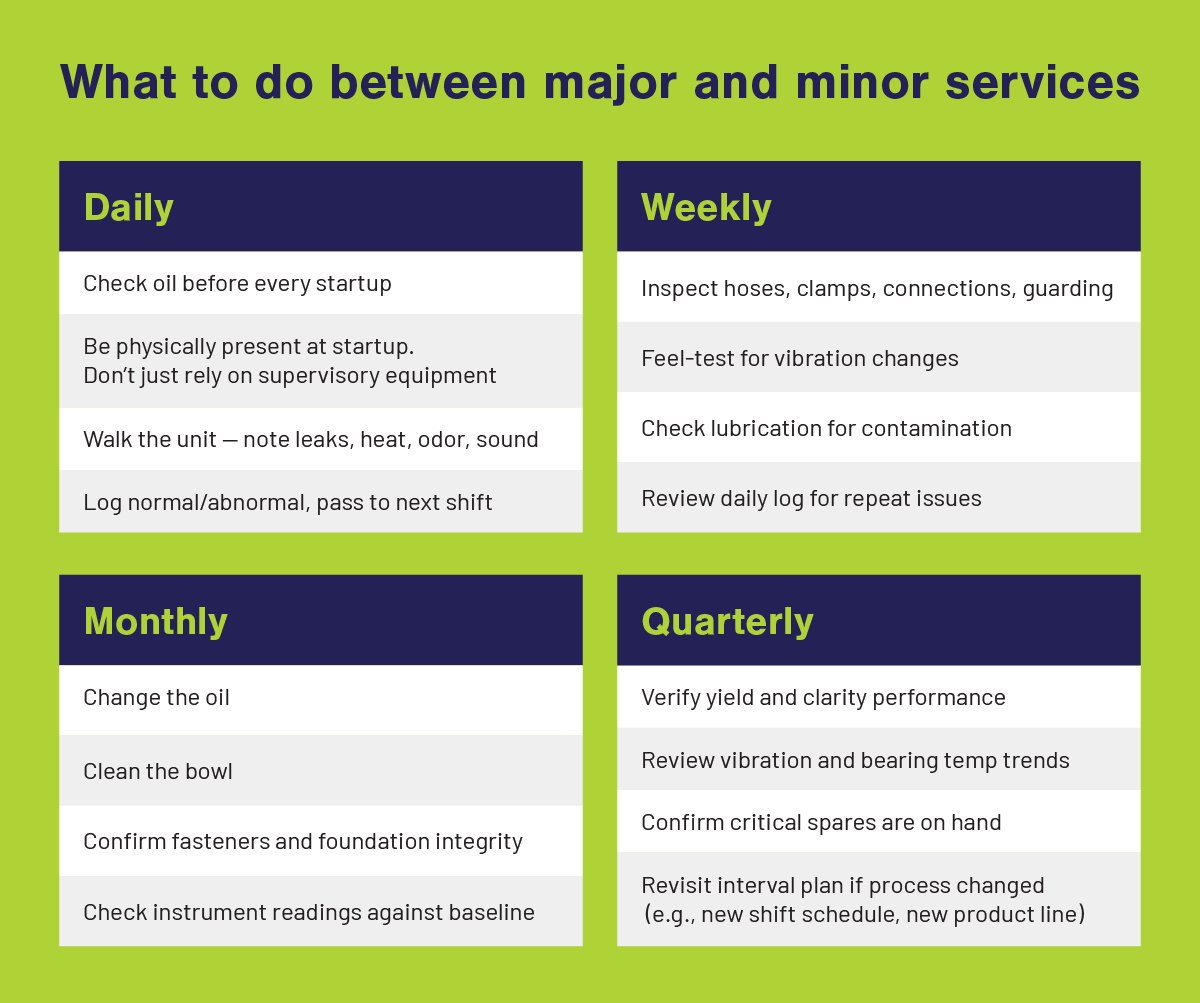
When it comes to having spare parts on hand, spindles, bearing housings, pumps, smaller bowl components, and motors can take weeks to procure if you don't already have them. How common your model is should shape how deep that stock goes. A widely used machine means replacements a day or two out; an uncommon one means your real target is closer to a full spare unit than a parts bin.
Signs it's time to call in a service tech.
Don't wait for the next calendar date if you see any of the following:
-
You're adjusting water, timers, or valve settings just to hold normal performance
-
New or worsening vibration
-
Rising or repeated bearing temperature alarms
-
Drop in product clarity or yield you can't explain
-
Leak that comes back after you've already tightened or adjusted it
-
CIP frequency creeping up because cleaning has quietly become the workaround for a performance problem
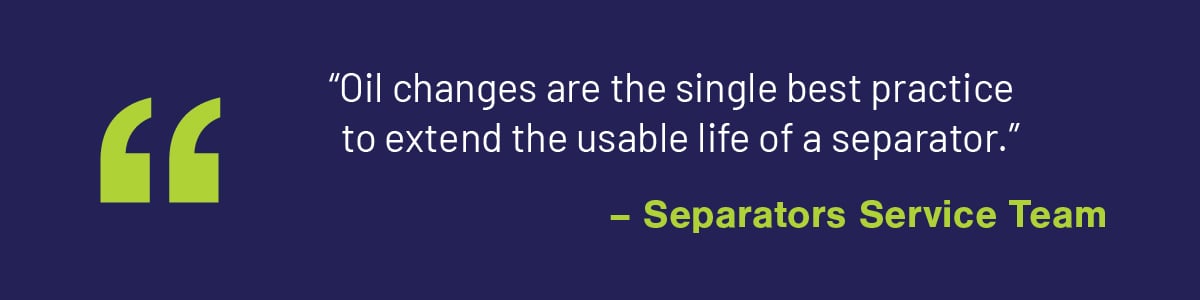
Normalizing a small sound or vibration is one of the most common ways a cheap fix turns into an expensive one — an oil change and a bowl cleaning resolve a lot of these before a scheduled service call becomes an emergency one.
Process changes matter here too. If you're moving from one shift a day to round-the-clock, plan on an extra minor service in your annual calendar — that's proven effective in the field. And if your CIP and controls are properly dialed in for your product, you generally shouldn't need more than three services a year. If you're exceeding that, it's less a scheduling problem and more a sign your equipment or process needs an actual fix.
What to handle in-house vs. what to escalate.
Most crews can safely handle oil changes, observation and logging, and routine connections without additional training. With the right experience, your team can typically manage inlet and outlet seals and gaskets, plus internal separator and water system connections. Opening and closing bowl assemblies and adjusting the operating water system take more specific know-how — know your team's actual comfort level before handing that off. Drive system work, and anything nobody on your crew fully understands, isn't a place to improvise; "I'll figure it out" is how a small deviation becomes a serious one.
If you don't already have a baseline to measure against, start simple: Track supervisory data if your controls provide it, or grab a temp gun and a handheld vibration pen, agree on where and how you're measuring, and start logging consistently. You can't catch drift if you don't know what normal looks like on your machine.
Keep the calendar, keep the uptime.
A realistic maintenance calendar is what keeps small issues from becoming unplanned downtime. Daily oil checks and honest logging catch more than most plants expect; monthly oil changes and bowl cleanings handle the rest. When something does need a service call, a report that flags what to watch next cycle and what to stage in parts keeps the calendar working for you between visits, not just during them.
Want a quick-reference version your crew can keep by the machine?